CLOUD Act – Its Impact on Law Enforcement
In March of 2018 U.S. Congress passed the CLOUD Act, which addressed a growing issue for domestic and international law enforcement, Internet service operators (such

In March of 2018 U.S. Congress passed the CLOUD Act, which addressed a growing issue for domestic and international law enforcement, Internet service operators (such

The 5G world is upon us! Which means Law Enforcement Agencies (LEAs) have a headache: 10X to 100X normal data rates are on the horizon. LEAs
“High-Risk” Providers Recently, we’ve heard a lot about “high-risk” network equipment providers and their potential security vulnerabilities. There is a fear they may be used
Today, the Internet of Things (or IoT) is a common part of our lives. Internet-connected thermostats enable us to make better energy decisions and we
Communication Service Providers (CSPs), including those that provide Over-the-Top (OTT) services, are obligated by law, to provide lawful intercept capabilities. This ensures that when law
Location information is gathered from connected devices including mobile phones. It is a critical data point which, when used by Law Enforcement Agencies (LEAs), tracks

Communications have shifted from traditional (voice, email and SMS offered by telecom operators) to encrypted, over-the-top (OTT) applications. Which unfortunately leaves law enforcement agencies (LEAs)

As bandwidth increases by up to 100x in the next 24 months, law enforcement agencies (LEAs) may find it difficult to manage the amount of
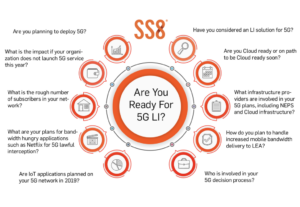
5G Brings on new challenges for regulatory compliance. SS8 is leading in 5G Lawful Interception (LI) mediation, with the 1st 5G deployment in production. We are

I was reading an article in the most recent issue of Science News that focused on the need for analyzing cellular phone communications by criminals.
THE DATA SILO DILEMMA FOR LAW ENFORCEMENT
How to Ingest, Filter and Query 5G Volumes
Webinar Presented by Kevin McTiernan