Intercepted Location Data Can Help Intelligence Agencies
Having location capabilities in a mobile network was originally an afterthought. The first Global System for Mobile (GSM) network was launched in Finland in 1991

Having location capabilities in a mobile network was originally an afterthought. The first Global System for Mobile (GSM) network was launched in Finland in 1991

Overview There are two broad types of surveillance capabilities and they are classified as Targeted Intercept and Bulk (Mass) Intercept. Targeted interception, or targeted surveillance,

5G is the most exciting new technology when it comes to wireless communications. Just like when 4G/LTE enabled many application developments that changed the way

In March of 2018 U.S. Congress passed the CLOUD Act, which addressed a growing issue for domestic and international law enforcement, Internet service operators (such
“High-Risk” Providers Recently, we’ve heard a lot about “high-risk” network equipment providers and their potential security vulnerabilities. There is a fear they may be used

Communications have shifted from traditional (voice, email and SMS offered by telecom operators) to encrypted, over-the-top (OTT) applications. Which unfortunately leaves law enforcement agencies (LEAs)

As bandwidth increases by up to 100x in the next 24 months, law enforcement agencies (LEAs) may find it difficult to manage the amount of
With 5G here, will 4G networks be going away? 5G is here. It’s being rolled out in countries around the world. You may have started
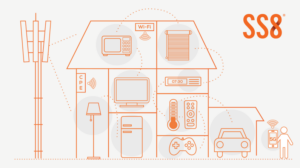
As telecom operators plan their rollout of the fifth generation (5G) of network services, two distinct services have emerged, mobile and fixed wireless access (or
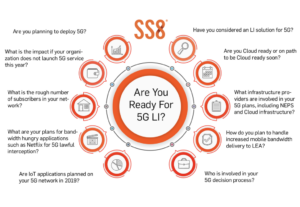
5G Brings on new challenges for regulatory compliance. SS8 is leading in 5G Lawful Interception (LI) mediation, with the 1st 5G deployment in production. We are