
Data sovereignty restricts the physical location of data within jurisdictional boundaries, and more consequentially, preserves local control over it. Growing requirements specify access limitations and auditable safeguards to prevent data from crossing borders without authorization. A multi-layer regulatory environment including the GDPR (General Data Protection Regulation), CLOUD (Clarifying Lawful Overseas Use of Data) Act, NIS2 (Network and Information Security), and the EU AI Act compounds these obligations, dictating related matters of data privacy, mandated access, secure infrastructure, and risk-based governance.
AI‑enabled lawful intelligence workflows amplify data sovereignty challenges, particularly because model training, inference, and governance can move data or derived insights across borders. The resulting increased reliance on resources in external jurisdictions can create new vectors for extraterritorial access. The EU push for sovereign AI is a concrete response to that concern, aiming to keep training, inference, and model governance under European control.
In addition to controlling data residency, technical requirements include auditable access controls, localizable retention and minimization policies, and processing pipelines that can be defended in court. Investigators face friction when evidential integrity must be preserved across borders, chain of custody is threatened by extraterritorial legal requests, or cross-border collaboration requires legal choreography beyond simple data exchange. SS8 helps agencies address data sovereignty requirements with deployments that keep investigative data under jurisdictional control while supporting lawful, auditable intelligence.
Jurisdictional Complexity Beyond Data Location
The distinction between data residency and data sovereignty is central to both concepts and is decisive for practitioners. Data residency answers the practical question of where data is physically stored, while data sovereignty frames the more complex legal question of how the laws of multiple jurisdictions combine to govern that data and who can compel access. A dataset sitting on servers inside an EU datacenter satisfies residency concerns, but forced exposure under extraterritorial statutes such as the CLOUD Act may still compromise sovereign control.
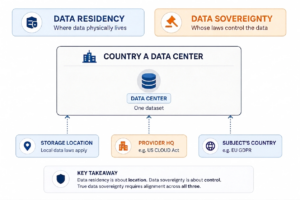
The differences between Data Residency and Data Sovereignty
International intelligence‑sharing agreements, bilateral treaties, and trade arrangements can create lawful pathways for cross‑border access that sit uneasily alongside national rules designed to keep private data and sensitive intelligence under home control. The reality that placing data on servers inside a country does not automatically insulate agencies from compelled disclosure forces practitioners to think beyond simple geography.
Because residency requirements are relatively straightforward to satisfy, even in public cloud environments, agencies often discover that the harder work is aligning procurement, contracts, and architecture to sovereignty objectives. Satisfying data sovereignty edicts requires contractual commitments that preserve legal control, supply‑chain transparency that reveals where components and services are governed, and deployment choices that align ownership, governance, and jurisdictional control. Mechanisms and workflows for cross‑border investigations and evidence sharing must therefore be designed as legal processes first and technical processes second, because a technically convenient architecture can create untenable legal exposure.
Building Workflows with Data-Sovereign Mandates
SS8 offers infrastructural flexibility that lets agencies align deployment choices with precise legal and operational requirements, giving decision makers a spectrum of options rather than a single, risky default. The most insulated posture is a fully on‑premises, air‑gapped deployment where the agency retains physical custody and exclusive legal control over data and processing. That architecture minimizes extraterritorial exposure and simplifies chain‑of‑custody questions, but it can be costly and slow to scale. Recognizing that modern investigations demand both assurance and agility, SS8 supports private cloud, sovereign cloud, and hybrid models that preserve jurisdictional control while using elastic resources.
Private or sovereign cloud deployments can be structured to keep ownership, governance, and supply‑chain assurances within the EU legal perimeter. Where investigations span multiple EU states, a single SS8 deployment can be distributed across multiple sovereign clouds so that each jurisdiction’s data remains under local control. At the platform level, SS8 enforces role‑based access controls so that only authorized users can view or act on specific datasets, enabling secure multi‑agency coordination without broad data exposure. Policy engines let customers tune retention, minimization, and access thresholds to their local legal requirements.
The ability to mix on‑premises, private, and sovereign cloud resources lets agencies modernize incrementally. They can keep the most sensitive workloads in the tightest legal perimeter while leveraging cloud elasticity for less sensitive analytics. AI and data sovereignty are intertwined in practice, as enabling lawful intelligence with advanced analytics requires AI stacks that can be trained, validated, and governed inside the jurisdictional boundary.
Operational Advantages for Law Enforcement
By maintaining the sovereignty of their data, law enforcement agencies avoid external bottlenecks associated with foreign control, legal processes, and infrastructure. That streamlined latency accelerates the pace of lawful intelligence cycles and preserves the momentum of investigations. Sovereign data environments also provide clear legal boundaries, ensuring that data access is governed by local statutes to reduce impacts from foreign subpoenas or conflicting cross‑border claims.
Retaining custody and residency of data preserves local control over governance requirements such as consistent retention policies and centralized audit trails. It also generally simplifies intelligence sharing across units and partner agencies while preserving chain‑of‑custody and evidentiary integrity. When that cooperation stretches across borders, agencies can exchange information through auditable, treaty‑aligned channels rather than with ad hoc transfers that invite legal friction.
By enhancing speed, control, and legal clarity, data sovereignty positions agencies to succeed against evolving threats and complex cross‑border investigations. SS8 platforms implement international standards and secure APIs for data-sovereign environments that unlock collaborative investigations without sacrificing control. SS8’s approach is designed to help agencies process and analyze intelligence within secure, policy‑compliant environments where organizations retain ownership, governance, and jurisdictional control over their data.
About Stef Waring

Stef Waring is a seasoned professional with over a decade in business development across cybersecurity, network operations, and intelligence sectors. Her expertise includes managing cross-functional collaborations, driving customer-focused outcomes, and achieving mission success. Known for her leadership in high-growth, dynamic environments, Stef holds degrees from Munster Technological University and Cork College of Commerce. Learn more about Stef on her LinkedIn profile here.
About SS8 Networks
As a leader in Lawful, Location, and Data Intelligence, SS8 is committed to making societies safer. Our mission is to extract, analyze, and visualize critical intelligence, providing real-time insights that help save lives. With 25 years of expertise, SS8 is a trusted partner of the world’s largest government agencies and communication providers, consistently remaining at the forefront of innovation.
Discovery is the latest solution from SS8. Provided as a subscription, it is an investigative force multiplier for local and state police to fuse, filter, and analyze massive volumes of investigative data – in real time.
Intellego® XT monitoring, data fusion, and analytics portfolio is optimized for Law Enforcement Agencies to capture, analyze, and visualize complex data sets for real-time investigative intelligence.
LocationWise delivers the highest audited network location accuracy worldwide, providing active and passive location intelligence for emergency services, law enforcement, and mobile network operators.
Xcipio® mediation platform meets the demands of lawful intercept in any network type and provides the ability to transcode (convert) between lawful intercept handover versions and standard families.
To learn more, contact us at [email protected].