

Investigators are facing a fundamental shift. The communications content that once drove many investigations is becoming harder to access as encryption, disappearing messages, and stronger device protections become commonplace. At the same time, smartphones, applications, networks, cloud services, and connected devices are generating unprecedented volumes of operational data about how they are used.
These traces are collectively known as digital exhaust. Digital exhaust consists of the non-content artifacts generated whenever a device, application, or network is used. It includes connection records, session metadata, location traces, device identifiers, system logs, and countless other operational records created as a byproduct of normal activity. Most of these artifacts are generated automatically, often without deliberate action by the user.
A single digital exhaust record rarely provides meaningful insight on its own. A location update, a session log, or a network event may appear insignificant in isolation. Their value emerges when they are correlated across sources and aligned over time, revealing patterns of behavior, movement, and association that would otherwise remain hidden.
Unlike content, many forms of digital exhaust persist even when communications are encrypted or messages are deleted. Devices continue to connect to networks, applications continue to generate metadata, and infrastructure continues to record operational events. These traces create an increasingly important source of investigative insight in environments where traditional content is limited or unavailable.
The challenge is that digital exhaust is fragmented across systems, vendors, protocols, and data repositories. Intellego XT helps investigators collect, normalize, and correlate these disparate artifacts, transforming isolated records into actionable intelligence. Combined with AI-assisted triage and analyst-driven investigation, digital exhaust becomes more than a collection of technical records. It becomes a framework for understanding behavior, movement, and relationships.
Tiny Traces of Identity, Movement, and Intent
The value of digital exhaust rarely comes from a single record. Its value emerges when multiple traces are correlated, aligned in time and space, and used to create context for one another. Through that process, investigators can uncover evidence of identity, movement, behavior, and association that would otherwise remain hidden. Even when communications content is encrypted, network session metadata can reveal that a connection occurred, when it occurred, how long it lasted, and the volume of data exchanged. In parallel, location-oriented traces such as RAN logs, Wi-Fi records, Bluetooth observations, and other proximity indicators help place devices in physical space and establish patterns of movement. CCTV timestamps and motion events can be correlated with device activity to corroborate presence and determine whether a person was nearby when a device was detected.
Beyond network and location data, some forms of digital exhaust reveal how a service or application was used without exposing the underlying content. SS8 tools and techniques, including E-PXE deep packet visibility, analyze encrypted session activity to identify protocol fingerprints, file transfer indicators, and application identifiers. These signals help analysts understand what type of activity occurred and identify the likely application involved, even when message bodies remain inaccessible.
Device-resident artifacts such as system logs, connection histories, and application metadata often persist after content has been deleted and can reveal that a file existed, where it was transmitted, or which accounts were involved. Advertising identifiers, public registries, subscriber records, and third-party datasets can enrich device traces with attribution clues, ownership information, and additional context.
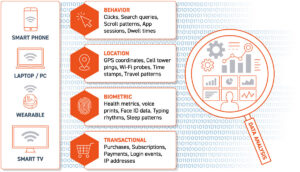
Digital exhaust enhances investigations when traditional content is limited or unavailable.
As a practical example, consider a mobile device during the course of a day. As it travels, it generates a series of seemingly unrelated digital traces. Smartphones, tablets, and computers routinely search for available (or recently used) Wi-Fi networks and familiar Bluetooth devices used in the past. In the process, connection attempts, discovery events, authentication requests, and other interactions may be recorded by wireless infrastructure, access points, enterprise systems, or point-of-sale systems, for example. These records often contain timestamps, device identifiers, network identifiers, and other metadata that establish when and where a device was observed. At the same time, cellular network records place the device in proximity to specific cell sites, while application sessions and network activity establish when the device was actively communicating – in many circumstances, the app will record very precise location information. CCTV systems may independently capture movement through physical spaces, creating yet another source of corroborating information.
Individually, each of these records provides only a narrow view of activity. When correlated together, however, they can establish where a device traveled, how long it remained at specific locations, which locations were visited repeatedly, and whether it was present during significant events. Over time, these traces can be used to build a pattern of life, identify associations between devices and individuals, and reconstruct movements with a level of detail that would be difficult to achieve through any single source alone.
This illustrates the power of digital exhaust. The intelligence does not come from a single record. It emerges when many independent traces are aligned in time, correlated across systems, and analyzed as part of a larger investigative picture.
Weaving Digital Exhaust Into Intelligence
Digital exhaust becomes valuable when it is transformed from isolated records into investigative context. Individual traces may reveal little on their own, but when correlated across sources and aligned over time, they can help investigators understand identity, movement, behavior, and association. This process of turning fragmented signals into meaningful insight is what transforms digital exhaust into intelligence.
Persistent traces left behind after data is deleted may frustrate a subject’s efforts to evade investigative visibility. While subjects may delete files or rely on encrypted messaging to deny access to content, logs may record the transfer of a file, timestamps may show a session occurred, and device artifacts can indicate that a file once existed. Even when the primary evidence is gone, the scaffolding often remains.
For example, when a user deletes a photo from a handset, forensic analysis may be unable to recover the image itself, but network activity may indicate that exact file was uploaded to a cloud service, while associated metadata may retain evidence of the transfer. Similarly, an encrypted messaging application may hide message bodies, but session metadata and device association events can reveal that communications occurred, when they occurred, and which devices or accounts were involved. Those residual signals can justify preservation orders, support warrants and subpoenas, or identify additional subjects of interest.
The investigative value comes from correlation. A cloud upload event, a device artifact, a location record, and a network session may appear unrelated when viewed independently. When aligned across time and linked to the same device, account, or individual, they can establish a sequence of activity that would not be visible within any single data source.
Intellego XT turns fragments of digital exhaust into operational intelligence by ingesting heterogeneous sources, normalizing identifiers, and surfacing relevant connections at scale, to build timelines, link graphs, and other outputs that generate insight. The platform reduces the manual effort of stitching together bits and pieces of information into a coherent whole, allowing analysts to focus more on investigative analysis and less on data preparation and correlation.
SS8 lawful intelligence workflows systematically require human validation and decision-making while also offloading manual, repetitive tasks so analysts can work more efficiently and effectively. AI assists analysts by identifying patterns, anomalies, entities, and relationships hidden within large volumes of digital exhaust while keeping investigators in control of the analytical process. They transform incidental digital exhaust into an operationally practical complement alongside other lawful intelligence sources.
As the landscape of encryption and privacy evolves, the ability to collect, correlate, and analyze non-content artifacts lawfully and effectively will become an increasingly important capability for law enforcement and intelligence organizations.
About Kevin McTiernan

Kevin McTiernan is a seasoned professional with over 20 years of experience in the security industry. His extensive expertise spans big data, cybersecurity, network security analysis, and regulatory compliance. As Vice President of Government Solutions at SS8, Kevin specializes in the implementation of advanced intelligence solutions for the U.S. Government, law enforcement, and the Five Eyes alliance. He is an accomplished public speaker and an adamant supporter and volunteer for the National Child Protection Task Force. You can learn more about Kevin on his LinkedIn profile.
About SS8 Networks
As a leader in Lawful, Location, and Data Intelligence, SS8 is committed to making societies safer. Our mission is to extract, analyze, and visualize critical intelligence, providing real-time insights that help save lives. With 25 years of expertise, SS8 is a trusted partner of the world’s largest government agencies and communication providers, consistently remaining at the forefront of innovation.
Discovery is the latest solution from SS8. Provided as a subscription, it is an investigative force multiplier for local and state police to fuse, filter, and analyze massive volumes of investigative data – in real time.
Intellego® XT monitoring, data fusion, and analytics portfolio is optimized for Law Enforcement Agencies to capture, analyze, and visualize complex data sets for real-time investigative intelligence.
LocationWise delivers the highest audited network location accuracy worldwide, providing active and passive location intelligence for emergency services, law enforcement, and mobile network operators.
Xcipio® mediation platform meets the demands of lawful intercept in any network type and provides the ability to transcode (convert) between lawful intercept handover versions and standard families.
To learn more, contact us at [email protected].