
Criminal organizations commit substantial financial crime at international border crossings, either connected to or independent of higher-profile violations such as smuggling and human trafficking. Many of these crimes abuse legitimate transportation channels to illicitly avoid paying import/export costs such as tariffs and duties or to evade economic sanctions. Trade fraud including mislabeling shipments also often directly supports smuggling prohibited cargos, and it extends to trade-based methods of money laundering.
Sophisticated mechanisms to exploit trade vulnerabilities rely on measures as diverse as false documentation, corrupt intermediaries, and shell companies. The crimes themselves are hidden in plain sight, among massive flows of legitimate international trade. Digital investigation of them draws on lawful intelligence using all those sources to construct, model, and visualize the flows of money, goods, and information, ultimately connecting the responsible people and organizations to them.
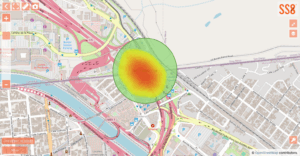
Location-based services are a critical tool for detecting and thwarting trade-oriented crime at national borders. Positioning data can help track and validate the origins, movements, and destinations of shipments alongside context such as declarations and commercial activities. Integration with customs-enforcement and other systems adds spatial awareness to investigations that helps correlate physical cargos with their digital contexts, providing novel insights that detect and interrupt organized border crime.
The Scope of Border Fraud and Misrepresentation
Criminal organizations manipulate legitimate commercial and trade processes in a variety of ways for illicit purposes. Invoice fraud is a common example, such as where goods are intentionally undervalued to avoid tariffs or duties. Conversely, invoice amounts can be artificially inflated, allowing importers to launder larger amounts of money by paying the invoice.
Similarly, malicious actors can falsify a shipment’s country of origin to get around export sanctions or quotas, typically routing shipments through another country to conceal their origin. For example, counterfeit electronics from China could be shipped through a Mexican shell exporter and declared to be of Mexican manufacture to avoid import restrictions and scrutiny.
Items may also be falsely classified according to Harmonized Tariff Schedule (HTS) codes to manipulate how they are taxed or restricted. In addition to evading fees, this approach is often used to smuggle prohibited goods, such as concealing gun parts by mislabeling them as “agricultural tools” or declaring narcotic precursor chemicals as “cleaning agents.” Inferior and counterfeit goods flow constantly across international trade channels, from fake pharmaceuticals to substandard auto parts, and most or all are misrepresented to facilitate their travel across borders. Fraudulent certificates of origin, safety, and compliance are often involved, which can further cloak the danger to society.
Organized crime measures to commit illegal import and export extend to complex operations that mimic legitimate business. Many shell import/export companies exist solely on paper to misrepresent illegal trade activities. Others may adopt stolen credentials from legitimate customs brokers to clear illicit shipments under the spoofed identities. Location-based services are an increasingly prominent tool in customs countermeasures and digital investigations for sophisticated international trade fraud and the other crimes associated with it.
Location-Based Enhancement of Visibility, Insight, and Enforcement
When available, positioning data directly reveals a shipment’s movements, showing its actual location as opposed to how that location is represented by third parties. Geo-tagging containers, trucks, or driver mobile devices reports objectively on a shipment’s location over time. That information can be cross-checked against the shipment’s declared point of origin and route to identify anomalies. The sources for these insights may extend far beyond the border itself as well as help correlate physical shipments to their financial trails.
Deviations from expected routes or unscheduled stops may indicate staging or tampering with loads during transport, such as switching legitimate goods for counterfeits or concealing contraband. Continuous, automated monitoring and analyst alerting for such digital footprints, as provided by SS8’s end-to-end location intelligence platform, is essential to implement these measures at scale. To bolster limited investigative resources, analysts can be automatically alerted of critical events such as cargo crossing a border at a non-designated point of entry.
Location services can also help detect fraudulent shipments that claim to originate from fake or non-operational facilities, a common tactic among paper-only shell companies. Tracking data can confirm that the goods were actually moved from the facility claimed on the manifest. The existence of an operational facility at the designated address can be verified by referencing satellite, drone, or prior shipment data.
SS8 Globe, a comprehensive location-based services application for law enforcement, is integrated with the SS8 LocationWise Passive Location Center to provide positioning functions including tracking, monitoring, geofencing, and alerting. That integration makes it possible for the location-based countermeasures introduced in this article, among others, to contribute to solving the complex law-enforcement challenges associated with international trade fraud. Visibility into how criminal organizations exploit international transport and trade helps disrupt their enterprises, bring them to justice, and protect society.
About Simon Mason

Simon Mason is a Solutions Architect at SS8 with over 25 years of experience in software engineering and telecommunications. With an emphasis in network location solutions, he is part of SS8’s LocationWise product team, helping law enforcement, government agencies, and emergency services locate and respond to public safety incidents. He holds a Masters in Computer Science from California State University and a BS in Industrial Engineering from California Polytechnic State University. To learn more about Simon, view his LinkedIn profile here.
About SS8 Networks
As a leader in Lawful and Location Intelligence, SS8 is committed to making societies safer. Our mission is to extract, analyze, and visualize critical intelligence, providing real-time insights that help save lives. With 25 years of expertise, SS8 is a trusted partner of the world’s largest government agencies and communication providers, consistently remaining at the forefront of innovation.
Intellego® XT monitoring and data analytics portfolio is optimized for Law Enforcement Agencies to capture, analyze, and visualize complex data sets for real-time investigative intelligence.
LocationWise delivers the highest audited network location accuracy worldwide, providing active and passive location intelligence for emergency services, law enforcement, and mobile network operators.
Xcipio® mediation platform meets the demands of lawful intercept in any network type and provides the ability to transcode (convert) between lawful intercept handover versions and standard families.
To learn more, contact us at [email protected].