
The effectiveness of public-key cryptography relies on the difficulty and time required to complete certain mathematical calculations, including with more powerful systems in the foreseeable future. Quantum computers upend those expectations, leveraging quantum phenomena to create a new processing paradigm poised to defeat classical public‑key algorithms such as RSA and elliptic-curve cryptography. While current quantum computing systems are not yet stable enough to level these attacks, their development continues at global scale within academic, commercial, and government research centers. The technology is expected to be generally available in a matter of years, and the UK’s National Cyber Security Centre recommends full migration to post-quantum cryptography (PQC) by 2035.
More immediately, “harvest now, decrypt later” (HNDL) attacks are currently viable, where bad actors gather encrypted data today and store it until future quantum systems will be able to crack its protections. Adversaries could potentially unlock years of stolen encrypted data, exposing sources, methods, and witness identities, compromising investigations as well as the safety of the people involved.
Modernizing cryptographic controls to overcome present and future dangers is more complex than just updating encryption algorithms, because cryptography is so deeply embedded across systems, protocols, certificates, and workflows. SS8 is helping facilitate the transition in the lawful intelligence sphere, including at the solution and organizational levels and with the development of international standards to reduce fragmentation and provide a clear upgrade path. This work builds on existing measures for multi-level hardening of the SS8 platform.
Standards-Aligned Roadmap to PQC
Complex, multi-vendor infrastructures with dense meshes of cryptographic controls make PQC readiness particularly challenging in mission-critical lawful intelligence environments. At the same time, this transition is an essential component of the overall modernization of lawful intelligence practices; structured migration guided by international standards helps reduce the effort and risk.
As a foundation for mitigating potential vulnerabilities, NIST quantum-resistant algorithms such as ML-KEM for key exchange and ML-DSA for signatures are currently being incorporated into 3GPP standards for lawful intelligence. SS8 contributes to this effort, helping establish integration mechanisms and define a hybrid transitional path that provides quantum resistance while maintaining compatibility with existing systems.
SS8’s history of strong governance, disciplined security processes such as SecDevOps, and mature cryptographic lifecycle management help safeguard PQC adoption. ISO 27001:2022 certification of the company’s Information Security Management System (ISMS) confirms that robust cryptographic controls and governance are embedded into engineering and operational workflows. Cyber Essentials Plus certification complements that posture by validating SS8’s implementation of foundational cyber hygiene mechanisms, including a technical audit of vulnerabilities that includes rigorous penetration testing.
That culture of security engineering hardens the PQC modernization path. At the same time, current capabilities of the SS8 platform including real-time analytics, auditability, and data visualization can help prevent and detect exfiltration threats associated with HNDL schemes. Measures such as anomaly detection and deep packet visibility into encrypted traffic help mitigate malicious actions, including those of privileged insiders and sophisticated state actors.
Future-Ready Certificate Management
Current and emerging capabilities of the SS8 platform help agencies navigate the quantum transition from a forward-looking position of strength. To maintain secure authentication and encrypted communication among thousands of distributed network elements, lawful intelligence systems must maintain large-scale, complex certificate management systems. While those requirements have increased dramatically with expanding 5G and virtualized architectures, many environments continue to rely on outdated manual, inconsistent processes. In many cases, for example, identical certificates may be used across network elements, or certificates may be deployed without expiration dates, creating systemic vulnerabilities that are deepened in the context of PQC.
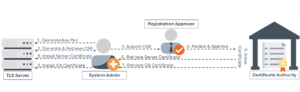
Through its work with 3GPP on Technical Specification 33.127, SS8 has implemented Lawful Intercept Certificate Authority (LI CA), a standardized framework for automated certificate lifecycle management. By eliminating resource-intensive certificate tasks and human error, this technology helps overcome existing shortcomings and implement data protection best practices. In particular, it enforces consistency and dramatically reduces the operational complexity of issuing, renewing, revoking, and securely storing certificates. It provides a future-focused basis for hardening existing certificate lifecycle management practices, as well as helping to shape a standards-based upgrade path toward PQC readiness. As NIST-approved quantum-resistant algorithms are implemented into 3GPP and ETSI specifications and additional standards-based PQC technologies emerge, LI CA will streamline their adoption.
Certificate Request Process
LI CA establishes the automation, governance, and interoperability underpinnings for present and future certificate management capabilities, a critical aspect of ongoing cryptographic hygiene for lawful intelligence. It is compatible with existing encryption including quantum-vulnerable measures, with a standards-based upgrade path to PQC. Together with other standards-development work by SS8, LI CA supports long-term strategy that helps safeguard the transition to quantum readiness without a forced, costly overhaul of certificate infrastructure. As PQC becomes mandatory in the coming years, agencies will be prepared to adapt at speed, with minimal operational friction and cutting-edge protections against emerging cyber threats.
About SS8 Networks
As a leader in Lawful and Location Intelligence, SS8 is committed to making societies safer. Our mission is to extract, analyze, and visualize critical intelligence, providing real-time insights that help save lives. With 25 years of expertise, SS8 is a trusted partner of the world’s largest government agencies and communication providers, consistently remaining at the forefront of innovation.
Discovery is the latest solution from SS8. Provided as a subscription, it is an investigative force multiplier for local and state police to fuse, filter, and analyze massive volumes of investigative data – in real time.
Intellego® XT monitoring and data analytics portfolio is optimized for Law Enforcement Agencies to capture, analyze, and visualize complex data sets for real-time investigative intelligence.
LocationWise delivers the highest audited network location accuracy worldwide, providing active and passive location intelligence for emergency services, law enforcement, and mobile network operators.
Xcipio® mediation platform meets the demands of lawful intercept in any network type and provides the ability to transcode (convert) between lawful intercept handover versions and standard families.
To learn more, contact us at [email protected].
Follow us on LinkedIn or X @SS8