

In a lot of enterprises, managing security certificates is treated as an afterthought, including in communication service provider (CSP) mediation environments. Where they can, many engineers have long avoided needing to deal with certificate renewals by setting expiration dates decades in the future, a poor security practice that extends the attack surface. Others use informal processes such as setting calendar reminders, building desktop spreadsheets, or creating bespoke, undocumented scripts; all these methods are brittle and often fail because of entropy and staff turnover. The results range from late-night firefight conference calls to financial losses from extended service interruptions and SLA violations.
Multiple forces are converging to increase the tempo of certificate issuance, expiration, and renewal. The Certification Authority Browser Forum (CA/Browser Forum) is advancing practices to gradually shorten certificate lifecycles, which will culminate in a requirement to renew them every 47 days effective March 15, 2029. At the same time, mutual TLS (mTLS) is becoming the norm across 5G interfaces; because mTLS requires both client and server certificates, the number to manage effectively doubles. Together, these factors multiply the operational load required for certificate management, making manual, informal practices no longer viable.
The SS8 platform provides an integrated, standards-compliant lawful intelligence certificate authority (LI CA) to formalize the certificate management lifecycle. The LI CA has operational automation built in that hardens security posture at the same time it improves efficiencies and reduces potentially costly errors.
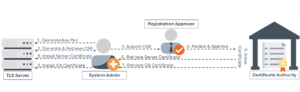
Certificate Request Process
Overcoming the Operational Gaps of Manual Certificate Renewal
Most certificate management workflows are inefficient and ineffective because of the tedious manual patterns they are built on. Typically, an individual or team generates a certificate signing request (CSR), transfers it to a local public key infrastructure (PKI) certificate administrator, which verifies it and forwards it to a certificate authority (CA). After the CA issues the certificate, it makes its way back by the reverse route to the original requestor, who waits for an email with the signed certificate.
Installation requires additional manual steps such as staging PEM files as delivered by email or other transfer mechanism, building and applying security profiles, and verifying connectivity. These steps are typically executed with a combination of GUI interactions, email exchanges, and file transfers, using processes that are slow, error‑prone, and hard to audit. Manual handoffs increase the risk of misplacing keys or installing the wrong certificate and create delay between issuance and deployment, while operators lack a single authoritative inventory of certificates and their remaining lifetimes.
The SS8 platform addresses these challenges with a standards-based, automated machine‑to‑machine channel for certificate lifecycle management based on Certificate Management Protocol v2 (CMPv2). Rather than relying on human signatures and email, end entities can initialize, request, and receive certificates programmatically. CMPv2 supports authenticated, auditable exchanges and enforcement of certificate profiles, so renewals can be triggered automatically as expiration approaches and certificates can be provisioned or revoked without human intervention.
The net effect of these measures is increased operational resilience, with reduced incidence of unplanned expirations and the elimination of fragile spreadsheets and single‑owner scripts in favor of a central source of truth for certificate state.
Standards-Based Lawful Intelligence Certificate Authority
3GPP specification 33.127 establishes that the ADMF must implement an LI CA to issue and manage certificates for lawful intelligence components. In practice, that means the LI CA is deployed as a sub‑CA of the operator’s PKI root, responsible for creating, maintaining, and revoking identity and encryption certificates used by LI components. The LI CA must provide a single certificate per LI component and support the operational controls and auditability expected of a PKI that underpins lawful intercept functions.
SS8’s Xcipio platform implements a purpose‑built LI CA that exposes lifecycle protocol interfaces for automation and which can be embedded within the ADMF or operated as a standalone service. It supports certificate profiles and end‑entity profiles so that issuance enforces policy constraints, and it publishes revocation information. The LI CA is designed to be the authoritative issuer and to integrate flexibly with the broader lawful intercept architecture, regardless of platform.
The SS8 LI CA implements the CMPv2 message set operators need, including support for initialization, certification, key-update, and revocation requests, coupling those protocol flows with GUI‑driven profile management and reporting. The standards-based, vendor-independent SS8 LI CA is well suited to use by large, multi-country CSPs subject to many differing regulatory regimes, especially MVNOs who must also interconnect with various host MNOs, roaming partners, and clearinghouses across borders – each requiring mutually authenticated TLS/SSL certificates. By managing certificates for Xcipio mediation components and third‑party mediation or access vendors alike, the SS8 LI CA creates a centralized certificate lifecycle across heterogeneous environments. This helps multi-country operators satisfy certificate requirements for multiple signaling protocols, maintain relationships with various certificate authorities, and overcome siloed, regional IT practices.
That flexibility is crucial to operators that run multiple mediation stacks, multi‑vendor RANs, and geographically distributed POIs. A single LI CA reduces duplication, enforces consistent profiles, and simplifies audits. Moreover, the LI CA’s lifecycle capabilities are not limited to lawful intelligence; the same automation and policy enforcement can be applied to other PKI domains within the operator’s estate, making the LI CA a reusable operational asset.
About Simon Mason

Simon Mason is a Solutions Architect at SS8 with over 25 years of experience in software engineering and telecommunications. With an emphasis in network location solutions, he is part of SS8’s LocationWise product team, helping law enforcement, government agencies, and emergency services locate and respond to public safety incidents. He holds a Masters in Computer Science from California State University and a BS in Industrial Engineering from California Polytechnic State University. To learn more about Simon, view his LinkedIn profile here.
About Rory Quann

Rory Quann is a Senior Solutions Engineer specializing in End-to-End Government Solutions at SS8 Networks and brings with him over 14 years of experience in the Lawful Interception and Data Analysis industry. Prior to joining SS8 in 2013, Rory worked for BAE System Applied Intelligence where he was focused on large scale Government deployments of Intelligence Solutions. Rory has held multiple positions in the Lawful Intelligence space ranging from Deployment Engineer, System Consultant, and Sales Engineer focusing on Country-wide Passive deployments. Rory is a Certified Microsoft MCSA Engineer and EMC Certified deployment Engineer. Learn more about Rory on his LinkedIn profile here.
About SS8 Networks
As a leader in Lawful and Location Intelligence, SS8 is committed to making societies safer. Our mission is to extract, analyze, and visualize critical intelligence, providing real-time insights that help save lives. With 25 years of expertise, SS8 is a trusted partner of the world’s largest government agencies and communication providers, consistently remaining at the forefront of innovation.
Discovery is the latest solution from SS8. Provided as a subscription, it is an investigative force multiplier for local and state police to fuse, filter, and analyze massive volumes of investigative data – in real time.
Intellego® XT monitoring and data analytics portfolio is optimized for Law Enforcement Agencies to capture, analyze, and visualize complex data sets for real-time investigative intelligence.
LocationWise delivers the highest audited network location accuracy worldwide, providing active and passive location intelligence for emergency services, law enforcement, and mobile network operators.
Xcipio® mediation platform meets the demands of lawful intercept in any network type and provides the ability to transcode (convert) between lawful intercept handover versions and standard families.
To learn more, contact us at [email protected].